Skin is the specialty that adapts best to remote consultation, and also the one most easily ruined by a bad photograph.
An online dermatologist can assess, diagnose and treat a large share of the commonest skin problems — acne, rosacea, dermatitis, psoriasis, urticaria, hair loss, nail fungus — from a good history and correct images, and can issue an electronic prescription where indicated. What they cannot do is examine with a dermatoscope, take a biopsy, or treat a lesion with cryotherapy or surgery. So for a mole that is new or changing, an online consultation is there to decide how urgently it must be seen in person — not to rule anything out. That is the boundary, and it is worth knowing before you book.
Good fit
What an online dermatology consultation handles well
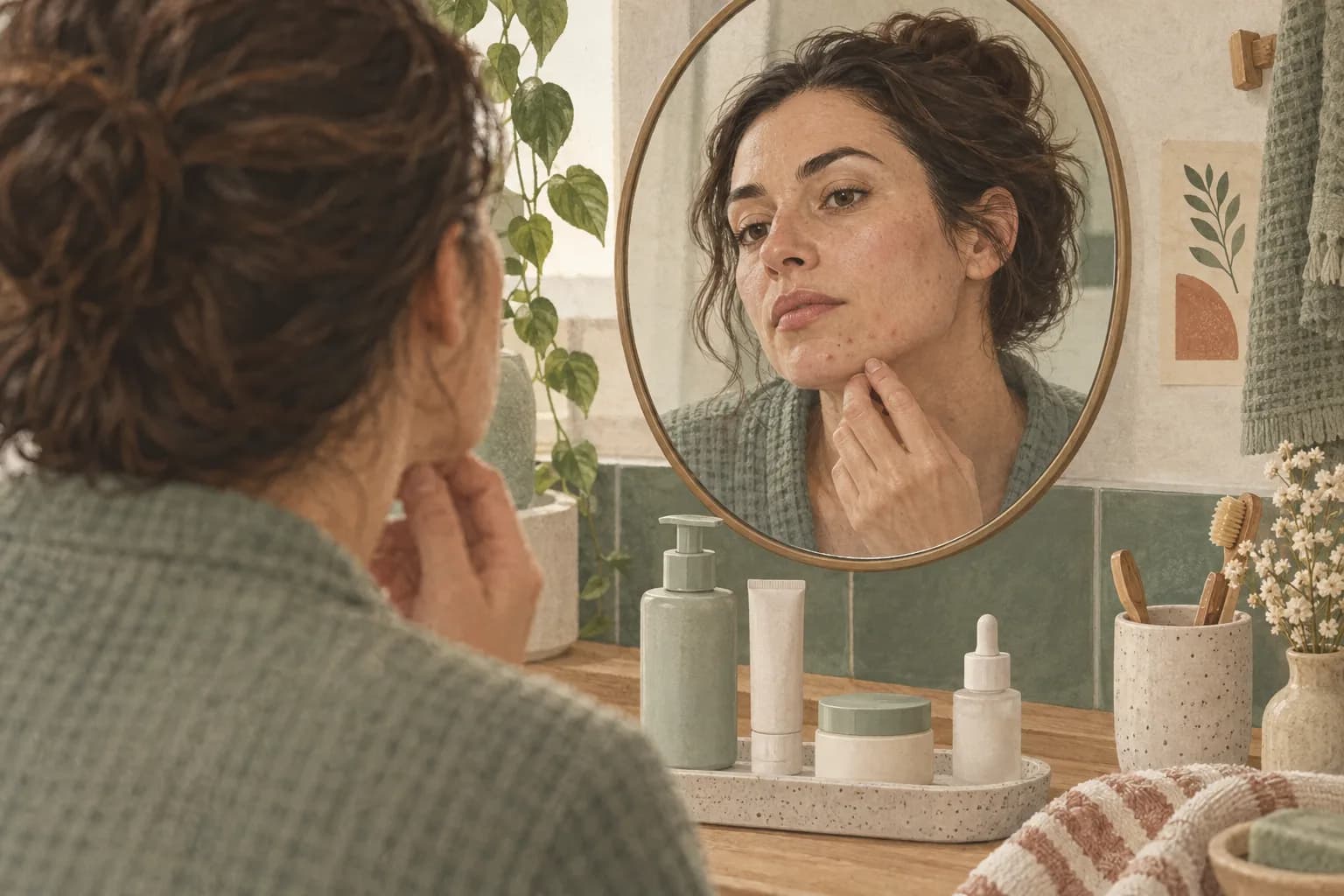
Dermatology is visual, and that favours remote consultation more than in any other specialty.
When the problem is a visible rash, an inflammatory lesion or a known chronic process, the dermatologist works from the same material they would use in the clinic: the history, the distribution of the lesions, their appearance and how they have evolved. Adding touch changes the outcome very little in most of these presentations.
- Acne — classification, choice of treatment, dose adjustment and follow-up of the response.
- Rosacea and seborrhoeic dermatitis — differential diagnosis and control of flares.
- Atopic dermatitis and eczema — steroid regimen, emollients, identifying triggers.
- Psoriasis — assessment of extent, topical treatment and criteria for systemic referral.
- Urticaria — management and investigation of causes where appropriate.
- Hair loss — diagnostic orientation, targeted blood tests and treatment.
- Nail and skin fungal infections — confirmation and treatment, with a sample if required.
- Review of a current treatment that is not working or is causing side effects.
There is also an advantage that is rarely discussed: remote consultation makes frequent follow-up practical. In chronic conditions, reviewing progress every few weeks with comparable photographs is usually worth more than one clinic visit every six months.
Transparency
What an online consultation cannot do
We put this early and plainly, because almost no teledermatology service writes it down.
A remote consultation does not include dermoscopy. The dermatoscope is the instrument that shows structures within a lesion that the naked eye and an ordinary photograph do not, and it is the basis of assessing pigmented lesions. No bare phone camera replaces it, however good the photograph: a dermatoscope removes the surface reflection — with polarised light or a gel interface — and lets the pigment network, the vessels and the structures beneath the horny layer be seen. A photograph captures surface colour and texture, not that.
The distinction matters because there is a middle ground: phone dermatoscope attachments exist that perform genuine dermoscopy. With one of those, remote assessment of a pigmented lesion stops being a photograph and becomes a dermoscopy. Without one, a clip-on macro lens and a polarising filter improve the image considerably, but they still do not amount to the examination.
- Dermoscopy — indispensable for moles and pigmented lesions.
- Skin biopsy — the only way to obtain a histological diagnosis. The procedure has to be in person; the referral for it can be issued from the online consultation.
- Surgical excision and cryotherapy — in-person procedures.
- Palpation of a lesion: its consistency, whether it is infiltrated or fixed.
- Full-body examination in people with many naevi or a history of melanoma.
- Lesions in places that photograph badly — scalp, skin folds, mucosa, genital area.
Your part of the work
How to take photographs that can be worked from
Most online consultations that stall do so because of the images, not because of the distance.
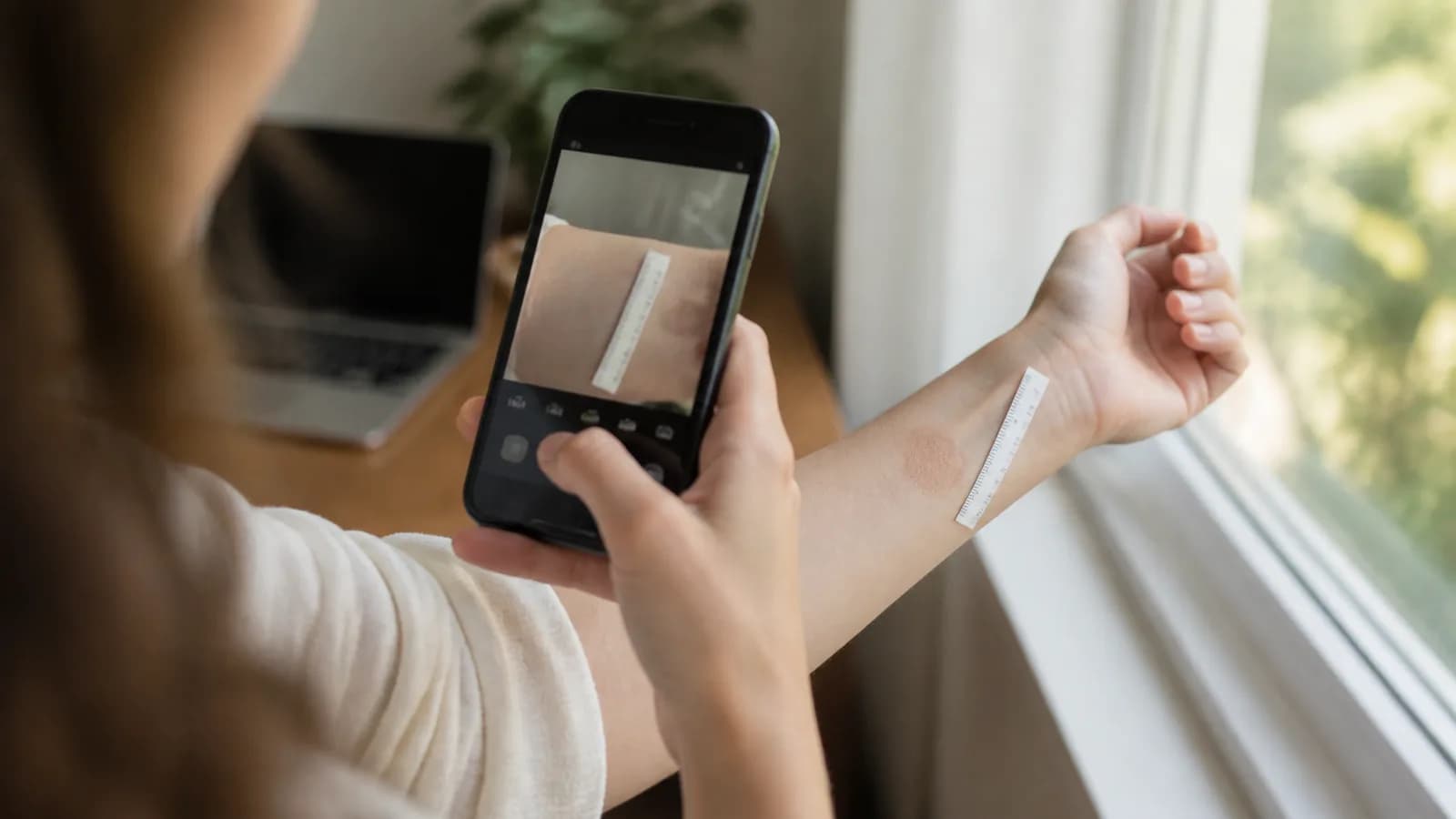
The aim is for the dermatologist to see three things: where the lesion is, what it looks like close up and how it behaves over time. A simple sequence achieves that on any current phone.
- Natural light, daytime, near a window. No direct flash, which flattens relief and falsifies colour.
- Three distances: one wide shot of the body area, one mid-range and one close-up of the lesion.
- Focus: tap the screen on the lesion before you shoot and check the image is not blurred.
- Scale: place a ruler or a coin beside it to give a size reference.
- No filters, no cropping and no retouching. Colour is clinical information.
- A clip-on macro lens costs little and genuinely improves the detail; a polarising filter cuts the glare and brings the image closer to what a dermatoscope sees.
- A series: if the problem is evolving, repeat the same shot, same light, same framing.
Add to the images what no photograph shows: how long it has been there, whether it itches, hurts or burns, whether it has changed in size or colour, what you have already applied and with what result, what medication you take and what allergies you have. With that, a remote consultation looks a great deal like a clinic one.
Priority
Moles and marks: when you have to be seen in person
No guide should reassure you about a mole. What it can do is help you decide the urgency.
The commonest rule for assessing a mole is ABCDE: Asymmetry, irregular Borders, Colour that is uneven or changing, Diameter that is increasing and Evolution. To that is added the ugly duckling sign: a mole that does not resemble that person's other moles deserves attention even if it meets few criteria.
- A new pigmented lesion appearing in adulthood.
- A mole that changes in size, shape or colour, or that starts to itch.
- A lesion that bleeds, ulcerates or does not scar over.
- A wound or crust that does not heal over a period of weeks.
- Personal or family history of melanoma, many naevi, or severe sunburn in childhood.
In any of those cases the correct route has three steps: an online consultation to decide the urgency, a written and dated referral, and in-person assessment with a dermatoscope, which is where the diagnosis is closed. A registered doctor can issue that referral — including one for biopsy — from the remote consultation; what is not done remotely is the procedure. A well-run online consultation will tell you exactly that, and will help you arrive with your history in order rather than waiting months not knowing whether to worry.
General information on skin lesions and prevention: Spanish Academy of Dermatology and Venereology.
The awkward question
«Free online dermatologist»: what actually exists
It is one of the most frequent searches and it deserves an honest answer rather than a sales page.
In Spain the route at no cost to the patient is the Sistema Nacional de Salud: you enter it through your primary care doctor, who assesses and refers to dermatology. Most autonomous communities also use teledermatology between primary care and the dermatology department, precisely in order to prioritise suspicious lesions. If you have a lesion that worries you, that is the pathway — and using it does not stop you consulting privately as well if you also want speed.
- Free chats and self-diagnosis apps are not a medical consultation and issue no prescription.
- A report signed by a registered doctor and an electronic prescription only come out of a real consultation.
- Faced with a suspicious lesion, the priority is being seen, not saving time with a chat.
You can check any doctor's registration in the CGCOM public register — ours as readily as anyone else's.
Safety
Signs that cannot wait
Some skin presentations are medical emergencies, and they are worth recognising.
- A rash with high fever, mucosal involvement, extensive blistering or skin peeling away.
- Red or purple marks that do not fade when pressed, with fever, neck stiffness or confusion.
- Swelling of the lips, tongue or throat, difficulty breathing or swallowing after a medicine or a food.
- An area of skin that is red, hot and painful and spreading quickly, with fever or feeling unwell.
- Pain out of all proportion to what can be seen, in an area of reddened skin.
In these situations call 112 or go to an emergency department. A booked consultation, online or in person, is not the right resource.
Global Health Spain
Next steps
Our dermatologists in Spain assess by video using the images you provide, and tell you plainly what can be settled today and what needs to be seen in person.
Have a lesion that worries you?
Prepare the photographs as explained above and book a consultation. If what we see needs a dermatoscope, we will say so and tell you how urgently a dermatologist should look at it in person.
Sources
Where to read more
Reference resources on dermatology, skin cancer prevention and medical registration in Spain.
Links open on external sites. Global Health does not perform biopsies or surgical procedures, and without a dermatoscope attachment no dermoscopy either: where a case requires them, we say so and issue the referral.
FAQ
Common questions
What can an online dermatologist diagnose?
With a good history and correct images, acne, rosacea, atopic and contact dermatitis, psoriasis, urticaria, fungal infections, nail fungus and hair loss are all handled well, as is follow-up of treatment already under way.
Is an online consultation any use for checking a mole?
It is useful for deciding urgency, not for ruling anything out from an ordinary photograph: assessment of pigmented lesions rests on dermoscopy, and a phone camera without an attachment does not replace it. With a phone dermatoscope attachment you do get real dermoscopy. Even so, for a mole that is new, changing, bleeding or unlike your others, the diagnosis is closed in person; the online consultation decides the urgency and issues the referral.
Can an online dermatologist prescribe for me?
Yes, where the assessment indicates it. A registered doctor can issue an electronic prescription after the consultation. What they cannot do is prescribe without assessing, or promise a particular treatment before seeing the case.
How do I take good photographs for the consultation?
Natural light and no flash, three shots — wide, mid and close-up — focused on the lesion, with a ruler or coin for scale, no filters or retouching. If the problem is evolving, repeat the same framing so the images can be compared.
Does a free online dermatologist exist in Spain?
The route at no cost to the patient is the Sistema Nacional de Salud, through your primary care doctor, who assesses and refers; many regions use teledermatology between primary care and the hospital department. Free chats and self-diagnosis apps are not medical consultations and issue no prescription.
Is it the same as seeing a dermatologist in person?
For inflammatory and chronic conditions the outcome is very similar, and follow-up is often better because it can be repeated more frequently. For pigmented lesions, biopsies, cryotherapy or surgery, an in-person visit is essential.