
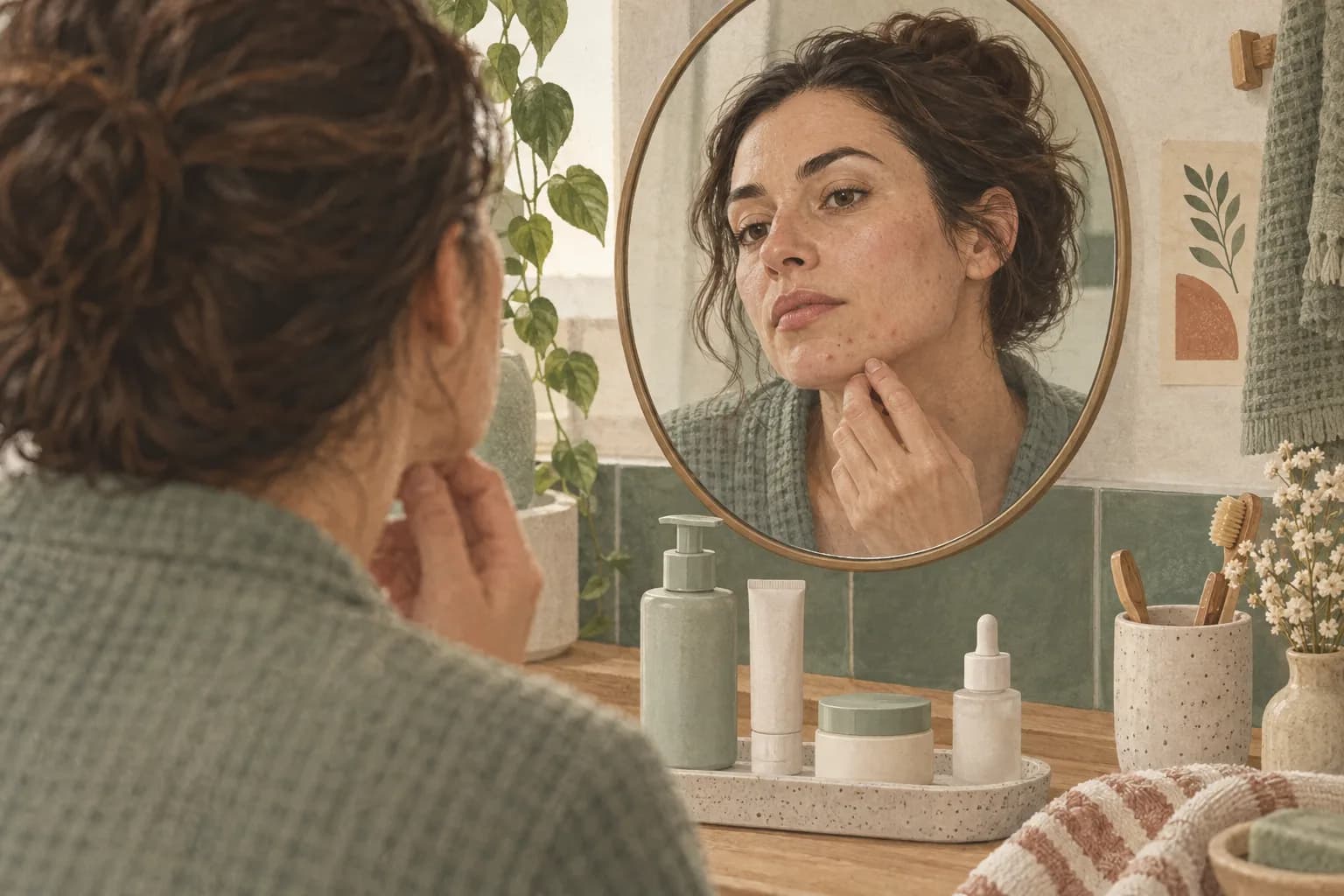
Adult acne: causes, treatment and when to seek advice
Acne can persist or begin in adulthood. The type of lesion, scarring and associated symptoms guide treatment and investigations.
Adult acne can continue from adolescence or appear for the first time years later. Blackheads and whiteheads can coexist with inflamed lesions or painful nodules. Treatment depends on these lesions, the risk of scarring and circumstances such as pregnancy. Assessment is usually clinical: having acne does not mean everyone needs hormone blood tests. Gentle skincare helps, but persistent, painful breakouts or those affecting your wellbeing deserve a consultation.
Adult acne
Adult acne: why it can appear after adolescence
Acne affects the hair follicle and sebaceous gland. It can appear on the face, chest or back, including in adults.
Excess sebum and blockage of the follicle contribute to lesions. Inflammation and the activity of Cutibacterium acnes also play a part. It is not a sign of poor hygiene, and scrubbing harder does not resolve the process.
Comedones are blackheads or whiteheads. Papules and pustules are inflamed lesions; nodules lie deeper and can be painful. Distinguishing them helps with treatment selection and assessment of scarring risk.
In adults, acne may persist, return or begin for the first time. Breakouts on the chin or jaw are not enough to diagnose a hormonal disorder: the menstrual cycle, other symptoms and examination also matter.
Sources: AEDV, Guide for patients with acne, pp. 4–10.
Adult acne
Hormonal acne, cosmetics and other factors: what to review
The consultation reviews medicines, cosmetics, family history and possible hormonal symptoms.
Note whether you have started a medicine or supplement, changed products or noticed a repeated relationship with your menstrual cycle. Do not stop prescribed treatment on your own initiative. A list of actual product names is more useful than describing them simply as 'spot cream'.
Irregular periods, increased hair growth or hair loss may justify hormonal investigation. Acne alone does not confirm polycystic ovary syndrome or require a full hormone panel.
If you think a food plays a part, discuss it alongside the rest of your history. The AEDV guide addresses possible dietary relationships but does not make food restriction a universal treatment. Avoid excluding entire food groups or replacing medical assessment with supplements.
Sources: AEDV, Guide for patients with acne, pp. 5–6, 9–10 and 12.
Adult acne
How acne is diagnosed and when tests are needed
Diagnosis usually relies on the history and examination of lesions. Tests are reserved for the suspicions raised by the assessment.
The clinician reviews duration, products used, response to previous treatments, scars and emotional impact. Other conditions can produce similar lesions, so a single photograph does not always establish the diagnosis.
Hormone blood tests are considered when there are signs of a hormonal disorder or a course that needs investigation. Cultures and biopsies are not routine tests for every breakout either. If the diagnosis is uncertain, an in-person examination may be necessary.
For an initial assessment, prepare the names of treatments and how long you have used them. If photographs are requested, use natural light, avoid filters and make-up, and send them through the clinic's specified secure channel.
Sources: AEDV, Guide for patients with acne, p. 10.
Adult acne
Adult acne treatment: a plan that needs follow-up
The plan may include topical treatment, oral treatment or a combination. The choice varies with severity, tolerability and the risk of scarring.
Topical options include benzoyl peroxide, retinoids and azelaic acid. Applying more or combining several active ingredients on your own can irritate the skin and make continuing treatment harder. Ask where to apply each product and how to introduce it.
Antibiotics need a defined indication and duration. The AEDV guide advises against using a topical antibiotic as the only treatment. Do not reuse leftovers or extend a course without review; the doctor decides the appropriate combination and when to change it.
Hormonal treatments may be considered for selected female patients after reviewing their history and contraindications. Oral isotretinoin is used for severe forms resistant to adequate treatments and requires specialist supervision and safety monitoring. It is not an option to start on your own initiative.
Response takes time. Before leaving the consultation, agree when to review the result and what to do if irritation or another adverse effect occurs. Changing products every few days prevents a sound assessment of tolerability and progress.
Sources: AEDV, Guide for patients with acne, pp. 11–14; AEMPS/CIMA, authorised isotretinoin patient leaflet, sections 1–2.
Adult acne
Pregnancy and retinoids: an essential precaution
Oral isotretinoin is contraindicated during pregnancy. Topical retinoids must not be used during pregnancy or when planning it either.
Where applicable, oral isotretinoin is subject to a pregnancy prevention programme with contraception and testing. The prescribing team must explain the requirements before treatment and the subsequent monitoring. Tell them if you are pregnant, trying to conceive or breastfeeding before starting any acne treatment.
Also report significant changes in mood or behaviour and other adverse effects. Safety information must be reviewed for the specific medicine to be used; general advice about 'retinoids' is not enough.
Sources: AEMPS, safety measures for retinoids; AEMPS/CIMA, authorised isotretinoin patient leaflet, section 2.
Adult acne
Daily skincare alongside treatment
Cleanse gently, choose non-comedogenic products and avoid picking at lesions.
- Wash skin without scrubbing or harsh exfoliants; follow the frequency recommended for your skin and treatment.
- Choose moisturiser, sunscreen and make-up suitable for acne-prone skin.
- Do not squeeze spots: picking encourages damage and scarring.
- Seek advice if a product causes marked irritation, swelling or a persistent reaction.
Intense burning does not prove a product is working. Colour changes after a breakout and scars are not the same either; they are assessed by their appearance and evolution. Control of active acne should be reviewed before selecting procedures for its after-effects.
Sources: AEDV, Guide for patients with acne, pp. 8 and 11–15.
Adult acne
When to seek help and what teledermatology can offer
Seek advice for painful nodules, scarring, persistent breakouts or a significant impact on your wellbeing.
The number of lesions alone does not reflect how much acne affects you. Explain whether it affects your work, relationships or mood. A sudden severe breakout with fever or feeling generally unwell needs urgent in-person medical care.
A dermatology consultation can help assess your case or review treatment. Suitability for online care depends on the images and symptoms. Our guide to what an online dermatologist can manage explains when an in-person examination is needed.
Keep a record of breakouts and treatments. The aim is to leave with specific instructions: what to apply, which effects to watch for and when to return. A consultation does not guarantee a prescription for a particular medicine.
Sources: AEDV, Guide for patients with acne, pp. 8–11.
Supplementary reference for the urgency of severe acne with general symptoms: NICE NG198, recommendation 1.4.1 on acne fulminans. It does not define the Spanish care pathway.
Next step
Prepare for a skin assessment
Check the available options and the professional's credentials before booking.
A consultation to review your case
Suitability for online care is assessed individually. Some lesions need an in-person examination.
Sources
Sources and editorial review
Adapted from the document supplied by the user and checked against Spanish sources on 27 September 2026.
The AEDV guide supports the general explanation. Pregnancy precautions and isotretinoin safety are based on AEMPS/CIMA. Author and reviewer: Dr. Alfredo del Valle Moreno Montañez. NICE is used only as a supplementary reference for the urgency of severe forms with general symptoms.
Common questions
Questions about adult acne
Is acne on the chin always hormonal?
No. Location may guide the discussion but does not identify the cause on its own. The menstrual cycle, other symptoms and examination help determine whether tests are needed.
Should I request blood tests before the consultation?
Not routinely. The clinician decides which tests provide information based on the history and examination. Bring a list of medicines, cosmetics and previous treatments.
Can I treat it with cosmetics alone?
Gentle skincare can support treatment. If there is pain, scarring, persistence or emotional distress, seek advice to confirm the diagnosis and choose a suitable plan.